Cart
0
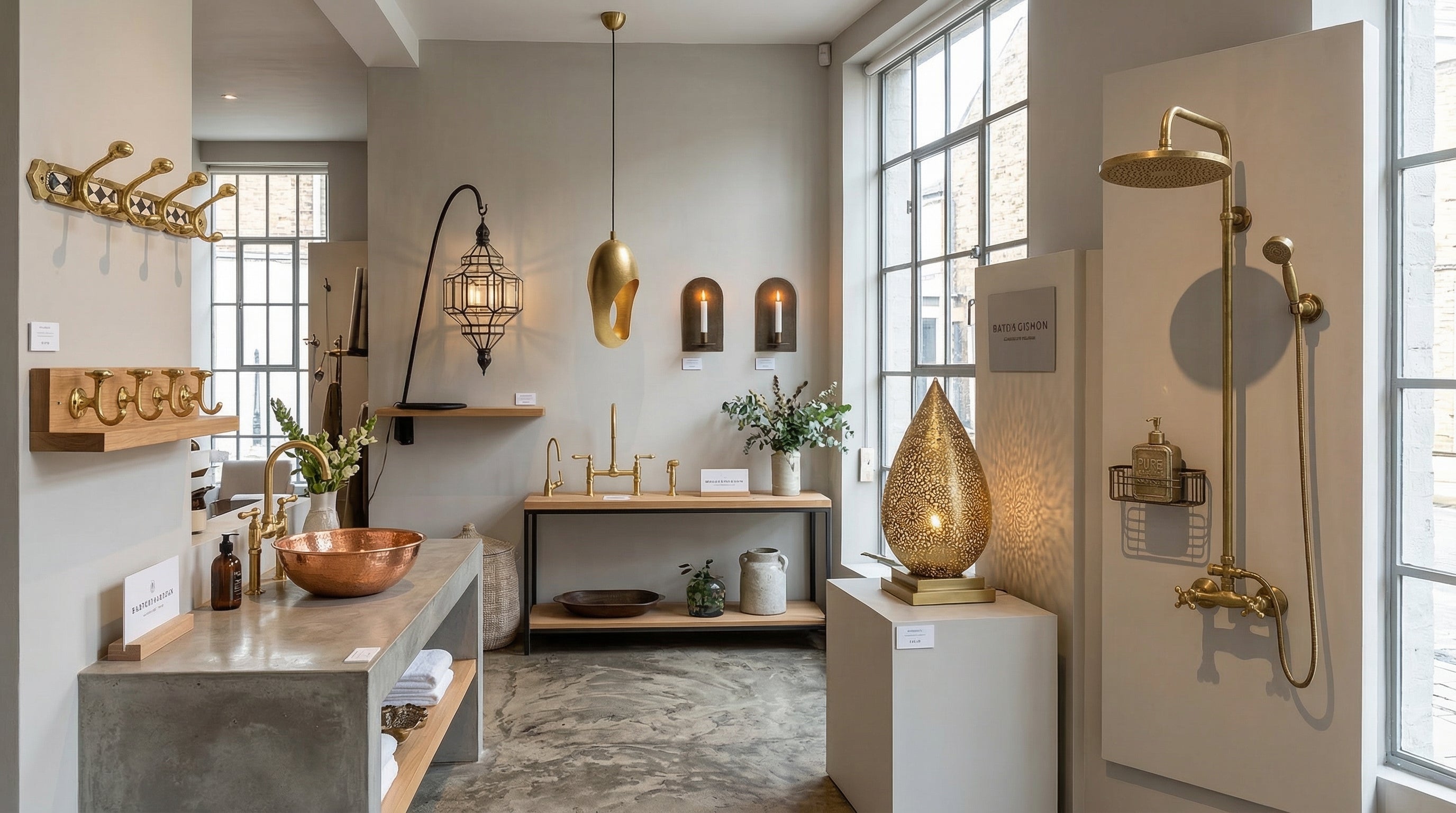
There is a quiet music to hand-hammered brass lighting. Each small strike from a Moroccan artisan’s hammer shapes more than metal—it tunes the way light unfurls across plaster, zellige, and stone. In Mediterranean interiors, where sun, shadow, and natural texture reign, this light does not simply illuminate; it warms, softens, and composes the room. This guide explores how to specify, style, and care for hand-hammered brass lighting so it feels both timeless and, unmistakably, yours.
Table of Contents
- What Makes Hand-Hammered Brass Lighting Unique
- Patina, Finish, and the Poetry of Time
- Layering Light in the Mediterranean Home
- Choosing Scale and Placement: Rooms, Heights, and Spacing
- Shadowplay: Solid Brass vs. Pierced and Glass Accents
- Styling by Room: Entry, Kitchen, Bath, Dining, and Bedroom
- Material Pairings: Zellige, Tadelakt, Stone, and Linen
- Installation Essentials: Bulbs, Dimmers, and Coastal Care
- Specification Checklist
- FAQs
- Conclusion
What Makes Hand-Hammered Brass Lighting Unique
The appeal of hand-hammered brass lighting is tactile and atmospheric. At a glance, you notice the subtle, organic undulation of a shade formed by thousands of strikes. Up close, the surface reveals shallow facets that scatter light like a gentle ripple over water. When illuminated, these facets avoid the harsh glare of machine-polished metal; instead, they yield a soft radiance that flatters natural materials—limewash walls, cut stone, handwoven textiles.
In Moroccan ateliers, the hammering is a conversation between hand and brass sheet. Slight variations are celebrated, not corrected. That’s why this lighting reads as soulful in Mediterranean rooms: it never feels mass produced, and it captures the lived-in elegance that defines coastal villas and riads alike.
Patina, Finish, and the Poetry of Time
Brass is a living metal. Left uncoated, it develops a warm patina that deepens from honey to amber, and eventually to a nuanced bronze. This evolution is part of its beauty, especially in sunlit interiors where natural oxidation catches the light at different times of day.
- Living brass: Unlacquered finishes age gracefully, responding to touch, air, and moisture. Wipe with a soft, dry cloth and embrace the gradual deepening of tone.
- Lightly sealed brass: A micro-wax or light seal can slow oxidation without silencing the character of the metal. This is ideal for those who prefer a steadier hue.
- Lacquered brass: Offers stable color with minimal maintenance. It presents a consistent, brighter sheen that feels crisp and contemporary, especially in high-humidity zones.
Coastal settings accelerate patina. To preserve a lighter tone by the sea, select a protected finish, add a topcoat of neutral wax seasonally, and ensure ventilation to minimize marine moisture. Conversely, if you love the soulful darkening of brass, choose unlacquered and let the climate be your collaborator.
Layering Light in the Mediterranean Home
Mediterranean interiors are studies in layered light—sun filtering through shutters, candle glow on white plaster, and evening pools of warmth near seating or art. To honor this language, build three layers:
- Ambient: Create a calm baseline with pendants, semi-flush mounts, or diffuse shades that bathe surfaces rather than spotlight them. Consider hand-hammered ceiling lights for living spaces where you want gentle, even illumination.
- Task: Focus on function at kitchen islands, reading corners, and vanities. For islands, a focused pendant or a row of refined fixtures, like brass kitchen island lighting, sharpens counter work but still glows warmly.
- Accent: Sculpt the room’s mood with sconces and table lamps. Wall lighting invites intimacy and flatters textures like tadelakt and carved wood; explore Moroccan brass wall sconces to halo niches, art, or arches.
Think of the space as a coastal evening: layers melt into each other. Dim each layer to shift the room’s rhythm from daylight bright to candlelit calm.
Choosing Scale and Placement: Rooms, Heights, and Spacing
Scale is the secret to making hand-hammered pieces feel bespoke rather than decorative. Use these guidelines as a starting point, then adjust based on ceiling height, window light, and furniture massing.
Pendants over Kitchen Islands
- Diameter: Each pendant typically spans 10–16 inches for smaller islands; 16–22 inches for larger spans. For a single statement pendant, go 24–32 inches.
- Quantity: Two medium pendants or three smaller pendants read balanced; avoid over-crowding.
- Spacing: Aim for 26–30 inches between fixture edges and keep end pendants at least 6–10 inches from the island edge.
- Height: 30–36 inches above the countertop; adjust one inch up or down depending on user height and sightlines.
Dining Tables
- Diameter: A rule of thumb is 1/2 to 2/3 the table width for a single pendant. For a long table, consider a pair to distribute light gracefully.
- Height: 30–34 inches above the table surface keeps sightlines clear and light softly framed.
Entries and Hallways
- Scale: Choose a fixture big enough to feel intentional. For an 8–9 foot ceiling, a semi-flush or compact pendant around 12–16 inches works beautifully.
- Rhythm: In long corridors, repeat smaller fixtures to create procession and calm; fix them at consistent spacing for visual cadence.
Bedrooms and Sitting Rooms
- Bedside task: Sconces should center 5–8 inches above the shoulder when seated, typically 48–54 inches from the floor depending on furniture height.
- Ambient: A drum or shallow bell shade gives restful distribution that flatters textiles and wall finishes.
Consider lumens and color temperature too. Warm-white LEDs around 2700K–3000K echo candlelight while preserving clarity. Use dimmers generously for control at every hour.
Shadowplay: Solid Brass vs. Pierced and Glass Accents
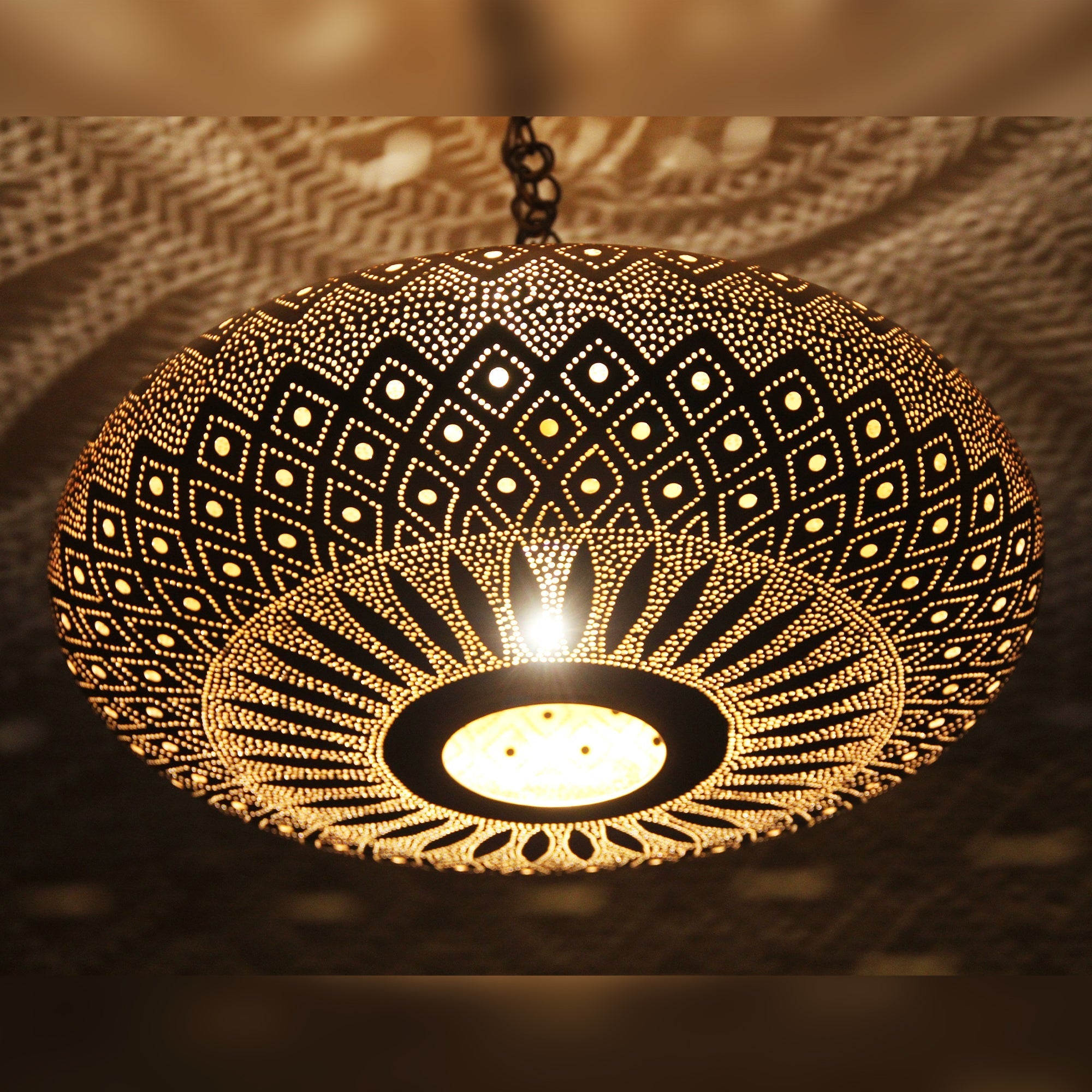
Hand-hammered brass can be left solid for a velvety glow or combined with pierced patterns and glass for a tapestry of light. Solid shades produce a calm, directional beam with a silky corona on nearby surfaces. Pierced patterns scatter pinpricks of light, animating ceilings and archways with lace-like geometry reminiscent of Moroccan courtyards at night.
If you love pattern but want to temper sparkle, place perforated pieces away from screens or mirrors to avoid visual noise, and choose more restrained fixtures for task zones. When you want color and glow together, layer with artful glass: consider the jewel-like profiles in our selection of pierced Moroccan glass lamps for alcoves, consoles, and bedside moments.
Styling by Room: Entry, Kitchen, Bath, Dining, and Bedroom
Entry
The entry sets the home’s tempo. A single, substantial pendant or semi-flush in hammered brass draws the eye upward while throwing a gentle arc of light across plaster. Flank a mirror or arch with understated sconces to layer glow at face level. For transitional homes that bridge modern and traditional, mix a crisp lacquered brass with a patinated console—elegant without ceremony.
Kitchen
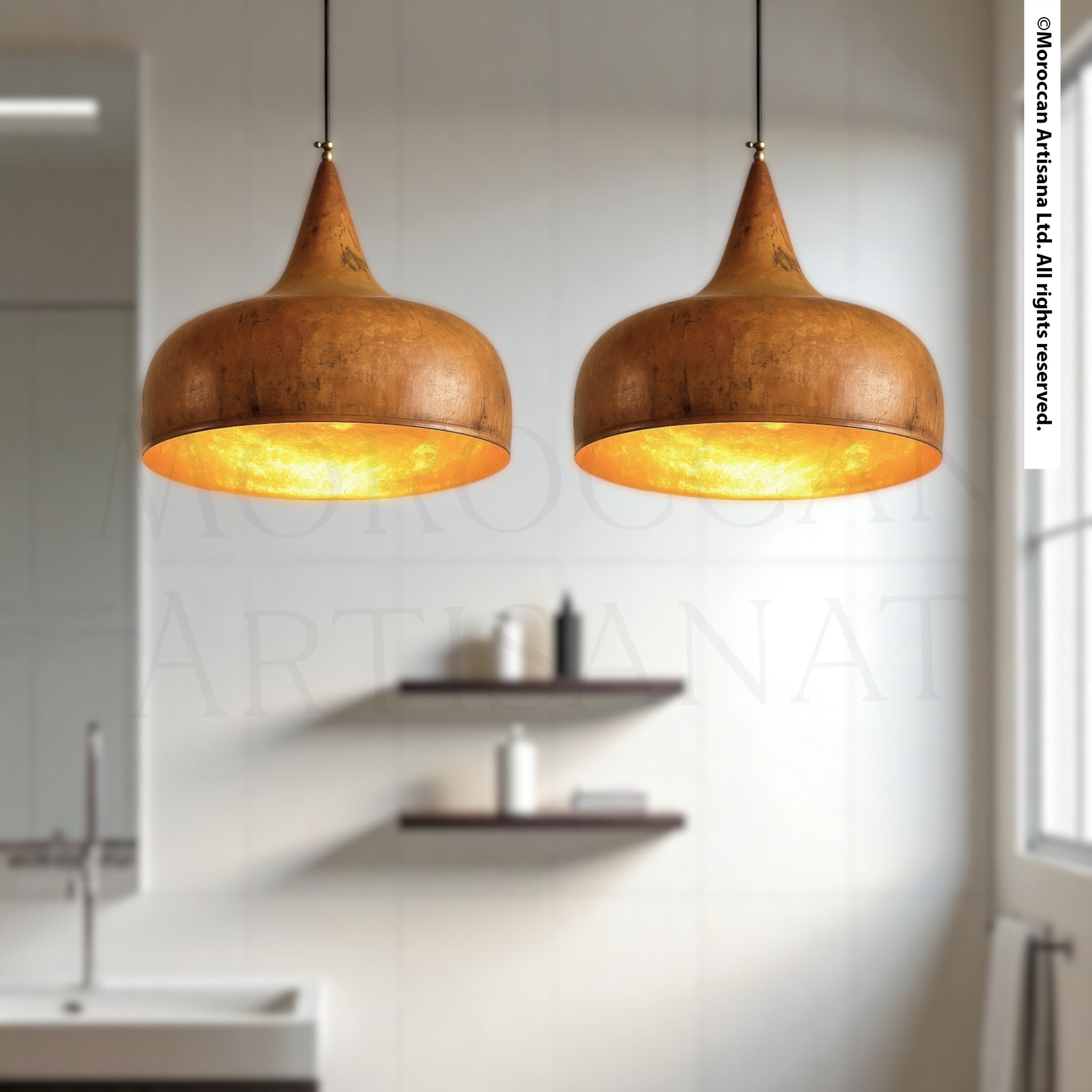
In Mediterranean kitchens, texture matters as much as function. Pair zellige tile with matte brass pendants whose hammer marks resonate with the tile’s soft irregularity. Over the island, a pair from our brass kitchen island lighting collection offers sculptural presence and refined focus. For general lighting, complement with understated ceiling lights in hand-hammered brass that keep the room even and glare-free.
Bath
The bath rewards a thoughtful, spa-like approach. On either side of the mirror, sconces placed at eye level minimize shadows and flatter skin tones. If your palette leans chalky white and stone, choose mid-toned brass that reads warm, not brassy. For cohesive detailing, echo the metal’s finish in taps and hardware, keeping the mix restrained—two metal tones maximum. Finish the story with subtle fragrance and a woven stool to introduce softness.
Dining
Dining lighting should invite long conversations. A shallow, wide bell pendant diffuses light over the table’s center while leaving edges slightly dim—a flattering effect for faces and food. For long tables, a pair of medium fixtures is better than a single overscaled pendant; the composition feels measured and supports balanced conversation across the length of the table.
Bedroom
Bedrooms benefit from layered pools of softness. Anchor the room with a warm ambient pendant, then bring light down to the body with sconces or lamps for reading. If you’re cultivating a serene, coastal palette, consider tonal variations—brass with linen shades, or hammered metal with a whisper of patina beside handwoven throws. A restrained use of pattern keeps the eye resting rather than racing.
Material Pairings: Zellige, Tadelakt, Stone, and Linen
Beautiful rooms feel inevitable because materials converse. Hand-hammered brass thrives in rooms with tactile finishes:
- Zellige tile: The irregular glaze and tiny bevels scatter reflections from brass, creating a chorus of gentle highlights.
- Tadelakt: Lime plaster with a soap-polished sheen. Brass grazes its surface with warmth, intensifying the finish’s depth and softness.
- Travertine and limestone: Porous stone drinks in light from below, making brass pendants look lit from within.
- Linen, wool, and rattan: Natural fibers calm the brightness of metal, ensuring your lighting reads elegant, not flashy.
Resist the urge to gloss everything. Allow matte and low-sheen finishes to dominate so the brass can play lead—never shouting, always glowing.
Installation Essentials: Bulbs, Dimmers, and Coastal Care
- Bulbs: Choose warm-white LEDs (2700K–3000K). Opaque or frosted bulbs soften hotspots within metal shades. Look for high CRI (90+) to flatter materials and skin tones.
- Dimmers: Non-negotiable. Dimming preserves evening intimacy and protects lacquered finishes from excessive heat over time.
- Coastal care: Wipe fixtures monthly with a soft, dry cloth. For living brass, a neutral microcrystalline wax once or twice a year will slow oxidation without sealing away character.
- Ventilation: In baths and near cooktops, adequate air movement keeps humidity and oils from settling on the metal.
Beyond the envelope of a room, plan how you’ll balance fixed lighting with portable pieces. A quiet, atmospheric table lamp can carry a room through movie nights and dawn coffee alike. Explore sculptural silhouettes in our selection of solid brass table lamps to complete the composition.
Specification Checklist
Before commissioning or ordering hand-hammered brass lighting, gather the following details to avoid revisions and returns:
- Finish: Living, lightly sealed, or lacquered—and target tone (pale, mid, or deep patina).
- Scale: Diameter, overall height, and canopy size; include ceiling height and furniture dimensions.
- Mounting: Junction box location, drop length, or rod/cord preference. For sloped ceilings, confirm swivel capability.
- Light level: Intended bulb wattage/LED lumen output and dimming type (TRIAC, ELV, or 0–10V for large spaces).
- Shade interior: Polished, satin, or matte; interiors subtly shift beam quality and warmth.
- Environment: Dry, damp, or near-coastal. This affects finish choice and maintenance plan.
- Companions: Coordinate with wall lights or table lamps so the room reads collected, not composed in one go. See our curated brass wall lights to echo form and finish without perfect matching.
Designing Atmosphere: A Mini Case Study
Imagine a sunlit dining room opening to a terrace. Floors are limestone, walls limewashed, and the table is warm oak. Over the center, a pair of mid-diameter hammered pendants float at 32 inches above the tabletop. In daylight, the metal reads as soft honey; at dusk, dimmed to 40%, the shades pour a quiet pool of light over dishes, letting the periphery of the room slip into softness. A single sconce near the arched doorway keeps a column of light alive, echoing the pendant’s finish and linking the scene to the corridor beyond. The result feels airy and old-world, but never nostalgic: an atmosphere built on texture, moderation, and time.
Alt Text Suggestions for Editors
When uploading images, use descriptive phrases to support accessibility and search clarity. Consider: Alt text suggestion: “Kitchen island with hand-hammered brass lighting casting warm glow over zellige backsplash.” Alt text suggestion: “Mediterranean dining room featuring hand-hammered brass lighting above oak table and limewash walls.”
Where to Begin: Curated Pieces to Explore
If you’re building from the ceiling down, start with sculptural ambient fixtures such as our hand-hammered ceiling lights. To layer intimacy along corridors and reading nooks, consider brass wall sconces with Moroccan detailing. For grounded pools of evening light, add a piece from our brass table lamps collection. And for task-forward, luminous kitchens that still feel soulful, explore our brass kitchen island lighting for refined silhouettes and balanced scale.
FAQs
Will hand-hammered brass lighting tarnish in a coastal home?
Yes, salt air accelerates patina on living finishes. Choose lacquered or lightly sealed brass if you prefer a steadier tone, wipe monthly with a soft cloth, and consider a neutral wax application twice a year to slow oxidation.
Can I mix brass with other metals?
Absolutely. Keep to two metal tones for harmony—brass with aged iron or oiled bronze reads elegant. Repeat each metal at least twice (a pendant and a sconce; a lamp and a hardware detail) to make the mix feel intentional.
What color temperature works best in Mediterranean interiors?
Warm-white bulbs between 2700K and 3000K preserve the gentle, sun-washed character of these spaces. Pair with dimmers to shift the mood from afternoon bright to evening soft.
How do I clean hand-hammered brass without removing patina?
Use a soft, dry microfiber cloth. Avoid abrasive pads or chemical polishes. For fingerprints on living brass, a light pass with a barely damp cloth followed by thorough drying is sufficient. If sealed, follow the maker’s care guidance.
Are perforated or pierced brass shades too bright?
Not if used thoughtfully. Pierced patterns sparkle; place them where pattern complements the architecture and soften with frosted bulbs or lower lumen output. For task zones, choose solid or partially perforated shades.
Do hammered brass fixtures work with contemporary interiors?
Yes. The material’s warmth offsets minimal lines beautifully. Choose cleaner silhouettes, slightly paler finishes, and restrained hardware to keep the look tailored and modern.
Conclusion
In Mediterranean rooms, light is as much a material as stone, plaster, or wood. Hand-hammered brass lighting brings the quiet confidence of craft to that equation—warmth without glare, texture without noise, and patina that grows ever more resonant with time. Begin with one piece that feels honest and sculptural, then let the room’s light evolve around it. When craft leads, atmosphere follows.