Cart
0
Introduction
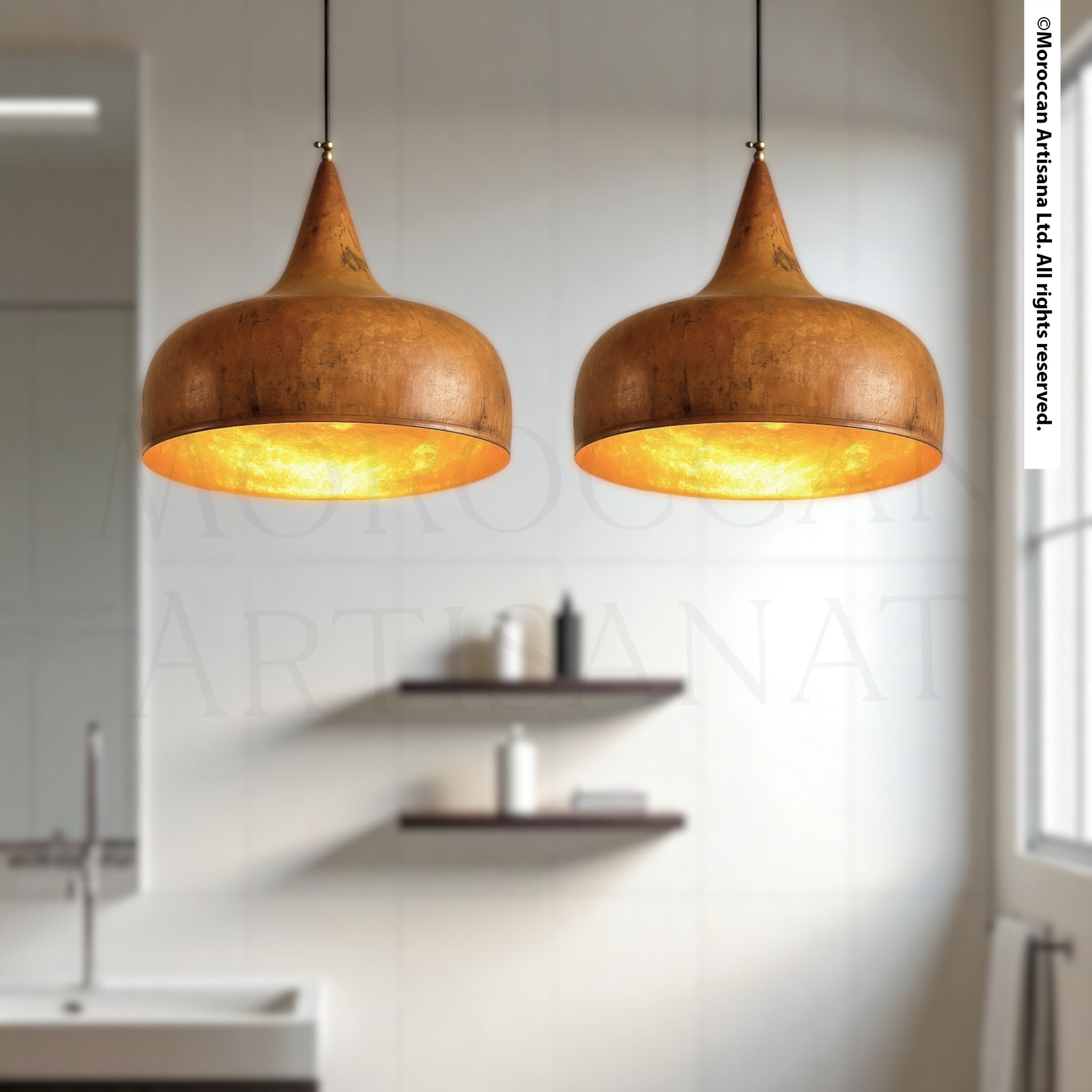
There is a hush that falls over a room when the light is right: a mellow glow on plaster, a soft reflection off stone, and a quiet rhythm of shadows that feels both timeless and new. That hush is the calling card of hand-hammered brass pendant lights—the kind that bring Moroccan artistry into Mediterranean-inspired homes with layered warmth, soulful texture, and lived-in elegance.
In the hands of master artisans, brass becomes more than a metal; it becomes atmosphere. The gentle dimples of a hammer mark scatter light into a dappling shimmer, while the weight and grain of solid brass anchor a room with presence. Whether you are refreshing a coastal kitchen, reimagining a travertine-clad foyer, or composing a dining room of soft curves and honest materials, hand-hammered brass pendants are the one detail that quietly ties everything together.
Table of contents
- What makes hand-hammered brass pendant lights special
- Design rules for hand-hammered brass pendant lights
- Where to use them: room-by-room styling
- Scale, height, and spacing essentials
- Color, materials, and finishes that sing
- Light quality: bulbs, temperature, and layering
- Care, patina, and living finishes
- Authenticity checklist: craftsmanship that lasts
- Project stories: three Mediterranean moods
- FAQs
- Conclusion
What makes hand-hammered brass pendant lights special
When you choose a hand-hammered pendant, you are choosing the slow work of a craftsperson: the measured strikes that create a pattern you can feel with your fingertips, the calibrated thickness that holds its shape for generations, and the subtle imperfections that only make the piece more beautiful. No two pendants are identical. This individuality is not incidental; it is the point.
Unlike spun or stamped fixtures, hand-hammered brass carries micro-facets that scatter light in a way machines cannot mimic. The result is an amber-lit ambiance that flatters skin tones, warms cool palettes, and makes evenings stretch. The finish lives, too: brass mellows with time, developing a soft patina that records how you use your home—the brush of a hand, the curl of steam from a simmering pot, the salt breeze drifting in through an open window.
For Mediterranean and Moroccan-inspired spaces, this living finish has cultural resonance. In riads and villas alike, age is an ingredient of beauty. Plaster softens, wood deepens, stone wears a velvet sheen, and metal learns the language of light. Hand-hammered brass pendants join this chorus with quiet authority.
Design rules for hand-hammered brass pendant lights
Good design is part instinct, part intention. To help your fixtures feel inevitable—like they were always meant to be there—consider these principles.
Let texture lead
In spaces built on limewash, tadelakt, or rough-cut stone, pick pendants with pronounced hammering and a matte or lightly waxed finish. Against smoother settings (lacquered cabinetry or high-polish stone), a subtler peen pattern and a gentle sheen create balance without glare.
Repeat the curve
Moroccan and Mediterranean rooms love softened geometry. If your table is oval, your island has radiused corners, or your archways are prominent, echo these curves in your pendant silhouette. The eye relaxes when shapes converse.
Compose, don’t match
Two or three pendants of the same family but slightly different diameters can feel more artful than strict twins—especially over long islands and dining tables. The kinship of finish unites them, while scale shifts keep the eye engaged.
Where to use them: room-by-room styling
Kitchen: the informal heart
Over an island, hand-hammered brass pendants offer task light with a softly diffused edge. If your island stretches beyond eight feet, vary the diameters or combine bowl and bell shapes for rhythm. For a cohesive, functional upgrade, consider a statement trio selected from our brass kitchen island lighting collection—pieces tailored for practical height, spread, and glare control.
Layer them with broader washes from the ceiling. A balanced scheme often pairs pendants with architecturally sensitive flush mounts or lanterns. Browse complementary styles among our artisan Moroccan ceiling lights to stitch the whole kitchen together without overwhelming the eye.
Dining room: glow over gathering
Choose a pendant that floats comfortably within your table’s footprint—neither too small to look tentative nor so large it blocks sightlines. A diffused under-shade or a softly curved interior helps prevent harsh reflections on glassware and polished wood. For long tables, two medium pendants often feel more intimate than one outsized piece.
Foyer: the welcome
In an entry, a single pendant with a dramatic profile becomes sculpture by day and lantern by night. If your foyer is tall, suspend it slightly lower than you think so the light engages the walls. And if you want to amplify the presence without visual clutter, flank the space with handmade brass wall sconces for a layered, candlelit mood that invites guests to linger.
Bedroom: the serene retreat
Bedside pendants free the nightstand and feel exquisitely tailored. Choose warmer bulbs, a narrower beam spread, and dimmers. Complement them with low-glow accents—our edit of solid brass table lamps provides a gentle counterpoint for reading nooks and consoles.
Living room: artful clusters
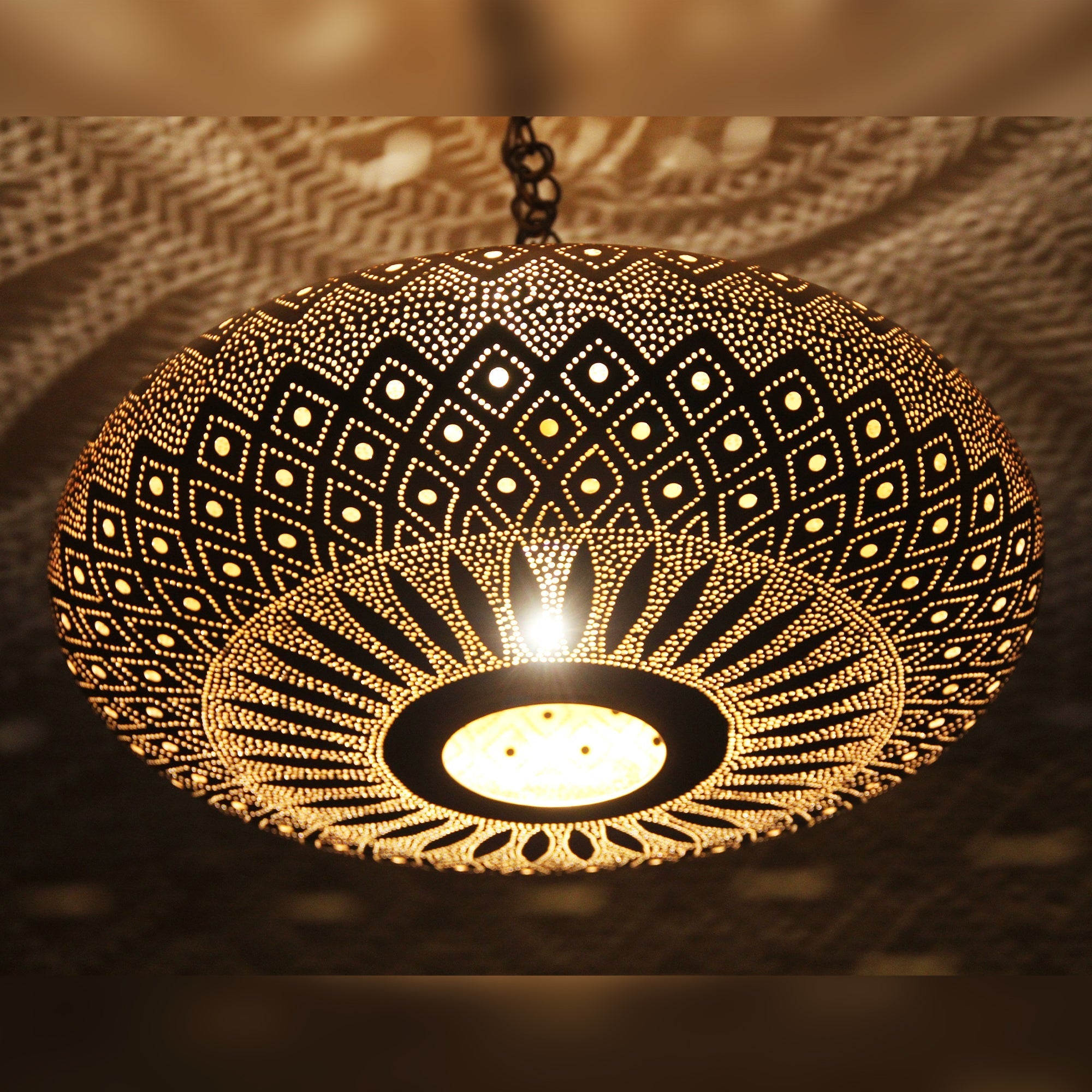
Over a coffee table or in a corner conversation area, cluster two pendants at staggered heights. The asymmetry sparks interest without fuss. If you prefer a touch of translucency, intersperse a pierced-brass pendant with a glass piece from our selection of ornate Moroccan glass lamps for a play of glow and shadow.
Powder room: a jewel box
Space is small; impact is large. A single compact pendant placed slightly forward of the mirror edge creates flattering light that minimizes shadows. Pair with a wall light to even out illumination—our brass wall lights offer refined options that won’t fight for attention.
Scale, height, and spacing essentials
Good proportions make a room feel resolved. Use these guidelines as a starting point, then fine-tune by eye in your actual space.
Diameter and length
- Over an island: a common formula is to size each pendant at roughly one-third to two-fifths the island’s width. For a 36-inch-wide island, a 12–14 inch pendant reads balanced.
- Over a dining table: aim for a pendant (or cluster) at 50–60% the table’s width. Two 14–16 inch pendants often feel more gracious than a single 28–32 inch fixture.
- In a foyer: if the room is, say, 10×12 feet, add the dimensions for a diameter guideline (22 inches here). Scale up slightly for double-height spaces.
Hanging height
- Kitchen island: 30–36 inches from countertop to the lowest point of the fixture. Adjust toward 30 inches if the shade flares wide; go slightly higher with smaller bells.
- Dining table: 30–34 inches above the tabletop, low enough for intimacy but high enough for clear sightlines.
- Open circulation: keep at least 7 feet of clearance under the pendant in walkways.
Spacing
- Between multiple pendants: a clean rule is to maintain at least one pendant-diameter of space between shades, measured edge to edge.
- Centering: if two pendants don’t center neatly over cabinetry or beams, trust visual center over strict measurements. Your eye is the final arbiter.
Color, materials, and finishes that sing
Mediterranean rooms live on honest materials: plaster, clay, stone, and warm metals. Against this canvas, brass offers a golden counterpoint that never feels flashy.
Walls and plaster
Limewash, clay paint, and tadelakt give light something to hold. Hand-hammered brass pendants graze these mineral surfaces with a textured glow, turning even a quiet corner into a moment.
Stone and tile
Calacatta, Arabescato, and travertine carry warm veining that harmonizes with brass. Zellige—especially in bone, celadon, or sand—adds a handmade echo to the hammer marks. If your palette leans cool, let the brass be your warmth: it will balance soapstone, Nero Marquina, and pale grey terrazzo with ease.
Wood and fabric
Bleached oak, walnut, and aged teak pair beautifully with brass. For soft goods, reach for linen, bouclé, or nubby cotton in ecru, clay, and sea-salt neutrals. The calm palette gives the metal’s glow space to perform.
Finish philosophy
Aged brass and unlacquered brass are friends of time, and both reward touch. If you prefer a steadier tone, a light protective wax preserves sheen without creating a glassy barrier. High-polish looks most contemporary; an eggshell sheen feels more coastal-Mediterranean.
Light quality: bulbs, temperature, and layering
The right bulb turns a beautiful fixture into beautiful light. Brass amplifies warmth, so choose sources that respect the metal’s character.
Color temperature
- Warm white (2700K–3000K) flatters skin, food, and natural materials. It is the sweet spot for most dining and living spaces.
- Warmer still (2200K–2400K) evokes candlelight—ideal for evening dimming or intimate corners.
Brightness and beam
- Islands benefit from roughly 800–1000 lumens per pendant when used as task lighting—less if your kitchen also has robust downlighting.
- A shaded or opaque hammered dome will push most light downward; a bell with a slightly open side will wash the surrounding walls for ambiance.
Layered scheme
Think in three layers: ambient (broad wash), task (focused), and accent (mood). Pendants can sit in any layer based on shade shape and brightness. Round out your plan with a supporting cast from our curated collections—consider pendants as your hero, complemented by ceiling mounts and wall lights drawn from artisan Moroccan ceiling lights and handmade brass wall sconces, then soften edges with the warm pools from solid brass table lamps.
Care, patina, and living finishes
Unlacquered or lightly protected brass is alive. It will deepen, mellow, and occasionally spot. Embrace 95% of it; edit the other 5% with care.
Everyday care
- Dust with a soft, dry cloth. For fingerprints, a barely damp microfiber cloth followed by a dry buff works wonders.
- Avoid harsh chemicals and abrasive pads. They erase character and can create uneven patches.
Patina choices
- If a water spot bothers you: gently dab with a 50/50 mix of water and white vinegar on a soft cloth, then dry. Test first in an inconspicuous area.
- If you prefer lasting sheen: a micro-layer of museum wax applied sparingly will slow oxidation without sealing the metal in plastic-like lacquer.
Remember: a living finish is a record of life. The softening that happens in the first months is the most dramatic, then the metal settles into a steady hum of gold.
Authenticity checklist: craftsmanship that lasts
True Moroccan hand-hammered brass pendants carry quiet hallmarks of craft. Use this checklist when choosing:
- Wall thickness: the shade feels substantial, not tinny; edges are finished smoothly.
- Pattern: the hammering is rhythmic but not machine-perfect; subtle variance signals a human hand.
- Joinery: seams are clean and soldering is refined; no sharp burrs.
- Finish: even coloration with natural range; not a sprayed-on faux patina.
- Hardware: robust canopy and cord grip; chain or stem built for the pendant’s weight.
- Provenance: workshop origin and artisan process are shared proudly, not obscured.
If you want to explore options curated with these standards in mind, begin with a scan through our brass kitchen island lighting and expand outward to complementary forms in ceiling lights and layered accents from Moroccan glass lamps.
Project stories: three Mediterranean moods
1) Sun-baked coastal kitchen
A pale oak island set on tumbled limestone needs warmth without weight. Two shallow hammered domes, 14 inches across, hang at 32 inches above the counter. The domes’ interior is lightly burnished, bouncing a golden glow onto veined stone. Uplighting from concealed cove fixtures completes the ambient layer, while a petite brass table lamp on a back counter creates a luminous echo at dusk.
2) Archway dining with zellige
An arched niche framed in cream zellige calls for vertical emphasis. A hand-hammered bell pendant descends from a stem finished in softened brass, centered 31 inches above an oval marble table. To avoid glare on glassware, the bulb sits just inside the bell’s lip, and a 2700K dimmable LED sets the scene. On the wall, a pair of finely peened sconces pull the rhythm of hammer marks across the room.
3) Stone-quiet foyer
In a narrow entry clad in Roman plaster, a single hammered teardrop holds the space. Hung slightly lower than typical (about 6 feet 10 inches to the bottom), it brushes light along the walls and finds texture in every trowel stroke. A small rug in undyed wool and an antique clay jar complete the welcome. The effect is calm; the memory lingers.
FAQs
Are hand-hammered pendants brighter or dimmer than smooth brass shades?
The hammering doesn’t increase raw brightness, but it scatters light more broadly and softly. You’ll perceive fewer hot spots and more ambient sparkle compared to a smooth, highly polished interior.
How high should I hang pendants over a kitchen island?
Start at 30–36 inches from the countertop to the lowest point of the fixture. Adjust for sightlines, pendant diameter, and how much openness the shade has on its sides.
Can hand-hammered brass go in a bathroom?
Yes, but confirm the fixture’s rating for damp locations and provide good ventilation. An unlacquered finish will patinate faster with steam, which many homeowners love for its depth and authenticity.
What bulb color temperature looks best with brass?
Warm whites (2700K–3000K) harmonize with brass and natural materials. For a candlelit mood in dining or bedrooms, 2200K–2400K is beautiful on a dimmer.
How do I clean fingerprints without removing patina?
Use a dry microfiber cloth first. If needed, a lightly damp cloth followed by a dry buff is safe. Avoid metal polishes if you wish to preserve the evolving patina.
Can I mix hand-hammered brass pendants with other metals?
Absolutely. Brass pairs well with blackened steel, bronze, and even nickel. Keep one metal dominant (usually brass), then accent with a supporting finish to avoid visual noise.
Conclusion
Hand-hammered brass pendant lights are more than fixtures; they are instruments of atmosphere. They celebrate Moroccan craftsmanship, honor Mediterranean materials, and deliver warmth that deepens with time. Choose by touch as much as by eye. Let texture lead, set the height with intention, and build a layered story of light with supportive pieces—from sculptural pendants and ceiling lights to brass wall sconces and the gentle pools of brass table lamps. In the end, the right pendants fade into the feeling of the room itself: gathering made intimate, stone made luminous, home made quietly luxurious.
Featured image alt text suggestion
Alt text: hand-hammered brass pendant lights illuminating a Mediterranean kitchen island with travertine and limewash walls