Cart
0
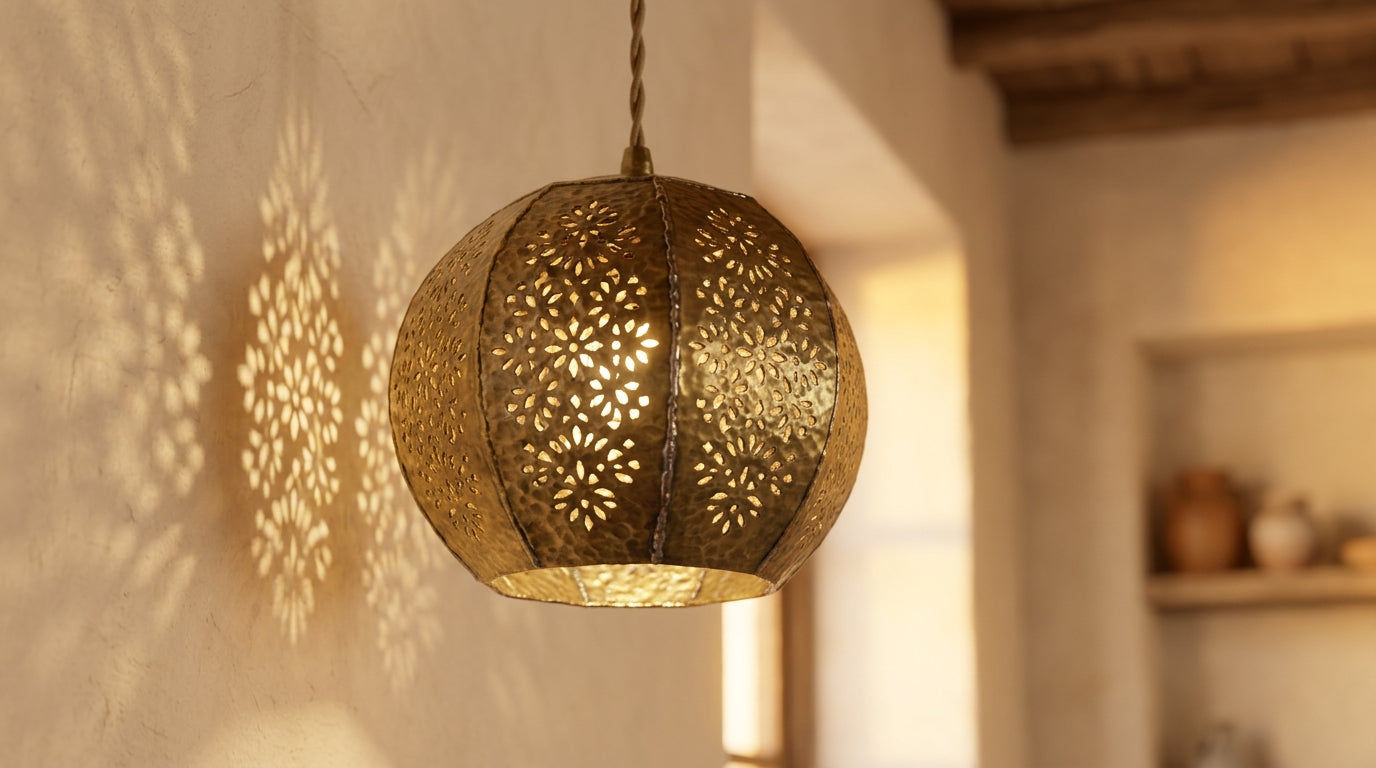
A glowing brass pendant looks like craft in almost any photo. The pierced patterns, the warm gold, the Marrakech-style shadows: factories copy all of it. The difference shows up in small details, and you can learn to read them. Seven signs follow. Check them one by one, in photos or in person, and the real thing stands out.
1. The hammer marks vary
Hand-hammered metal never repeats itself. Each strike lands at a slightly different angle, depth, and spacing, so the surface looks lively and a little irregular. Machine presses stamp the same dimple over and over, often in a tidy grid. Zoom into a product photo and compare two spots on the same shade. Identical dents mean a press. Uneven, overlapping dents mean a craftsperson with a hammer. Small flaws prove the point. A hammered brass dome pendant from a real workshop shows this variation across the whole shade.
2. The pierced pattern has human fingerprints
Moroccan artisans in Fez and Marrakech trace a design onto the metal, then punch or pierce it by hand, then file the edges. Study the cut-outs. Crisp edges with slightly uneven spacing suggest a hand at work. Tiny differences in hole size from one row to the next suggest the same. Laser-cut patterns look flawless but flat, with every hole identical and every edge razor clean. Perfection sounds like a compliment here. It usually signals a machine.
3. The seams show handwork
Look where the metal joins. Craftspeople roll flat brass sheet into a cone or cylinder, then solder the seam by hand. That seam often shows a thin line, a faint color shift, or a small ridge that they file and polish smooth but never erase. Factories spin or press shades from a single piece, which leaves no seam at all. Check the inside edge of the shade and the rim, since those spots hide the least. A neat but visible seam is a good sign.
4. The weight feels right
Solid brass weighs about 8.5 grams per cubic centimeter, roughly three times the density of aluminum. A real handmade pendant feels heavy for its size, and the metal feels thick when you tap the rim. Thin, light shades usually mean a cheaper alloy or paper-thin sheet. Check the listed weight against fixtures of a similar size. Weight also affects installation, so confirm that your ceiling box or hook can carry the load. A Moroccan brass pendant light in a large size can need extra support.
5. Matching pieces differ slightly
Buy a pair of wall lights and measure them. Handmade twins land within a few millimeters of each other, yet they never match exactly. The curve of one edge may run a little tighter, or the pierced leaf pattern may sit a hair higher on one side. Factories deliver identical sets down to the last detail. Differences between two pieces do not signal a defect. They signal that a person made each one separately. A set of Moroccan brass wall sconces gives you a quick test case.
6. The finish carries tool marks and uneven color
Hand finishing leaves traces. Look for faint polishing swirls, tiny file marks near the edges, and patina that sits a little deeper in the recesses. Engraved lines on a handmade shade vary in depth, since the tool shifts as the artisan works. Machine-etched lines look uniform and shallow. Color matters too. Oxidized or antiqued finishes made by hand show soft gradients. Spray-applied finishes look flat and even. Unlacquered brass will keep changing as it ages, and that change belongs to the charm.
7. The seller shows the maker
Real craft leaves a paper trail. Look for a named workshop, a city such as Fez or Marrakech, photos of artisans at work, and honest notes on production time. Handmade lights often take weeks, not days, to finish. Check how the seller handles electrical parts, since a serious shop offers wiring for your region and lists bulb type, socket, and safety marks. Vague phrases like “Moroccan style” or “inspired by” deserve a second look. Read the About Us page of any seller you consider and see how specific the story gets. Specifics beat slogans.
Spotting craft takes practice, not luck. Zoom in, ask questions, and trust small flaws over perfect symmetry. A handmade fixture earns its price in hours of labor and solid metal, and it repays you with a pattern that no factory can duplicate. Not sure where to start? Browse the Moroccan ceiling lights and apply the seven signs to each listing. The ones that pass will stand out fast.
FAQs
How can you tell if a Moroccan lamp is handmade?
Look for uneven hammer marks, slightly irregular pierced patterns, visible hand-soldered seams, and small differences between matching pieces. Heavy weight and a named workshop add confidence.
Are Moroccan lamps really made by hand?
Many are. Artisans in Fez and Marrakech still shape, pierce, and engrave brass and copper by hand. Factories also copy the style, so check the signs before you buy.
Why do authentic Moroccan lamps cost so much?
Each piece takes hours of skilled labor, from cutting and hammering to piercing, soldering, and finishing. Solid brass also costs more than plated steel or aluminum. Handmade pendants often range from about $150 to over $1,000, depending on size and detail.
What metals do Moroccan light fixtures use?
Brass and copper lead the list. Some fixtures add iron frames, colored glass, or raffia. Solid brass lasts longest and ages with a warm patina.
How do you know if a Moroccan lamp is real brass?
Hold a magnet to it. Solid brass does not attract a magnet. Check the weight too, and scratch a hidden spot lightly. Brass shows yellow-gold metal underneath, while plated steel shows gray.