Cart
0
Moroccan Carved Wood Doors: Cedar vs Lemonwood, Sizing, and How to Use Them Indoors
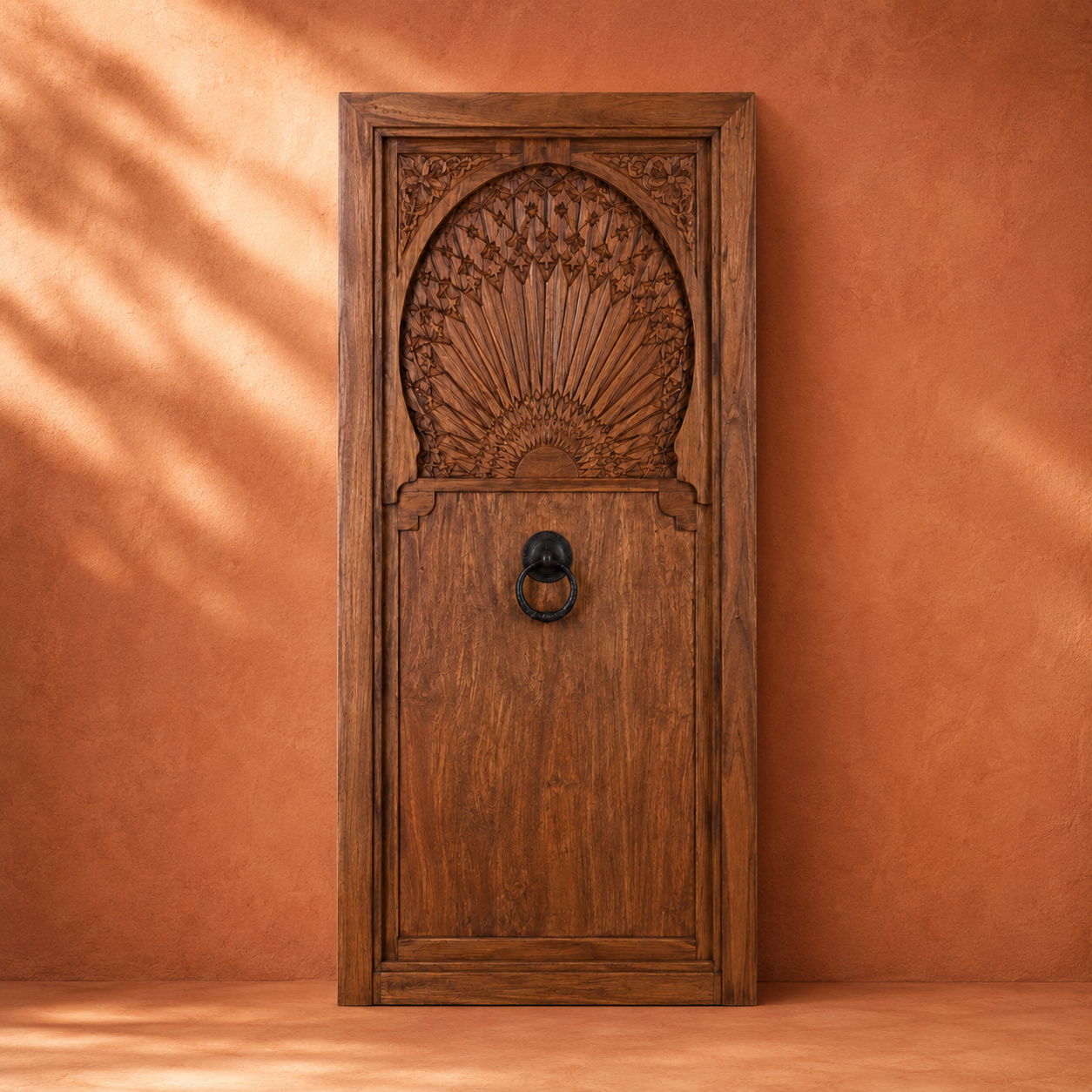
A carved Moroccan door does more than open and close. Artisans in Fez, Marrakech, and Essaouira spend days chiseling geometric patterns, arabesques, and star motifs into solid timber. The result works as a doorway, a wall feature, or a headboard. This guide compares the two woods most buyers meet, cedar and lemonwood, explains how to size a door, and shows how to use one indoors.
What Makes a Moroccan Carved Door Different?
Moroccan woodworkers cut deep relief patterns by hand, often with chisels and gouges. Many doors follow Islamic design traditions: repeating geometry, interlaced stars, and floral curves. Some carry a pointed or horseshoe arch, and others use a plain rectangle. Makers often finish the surface with natural oils, paint, or inlaid metal studs. Every piece differs, because hand carving leaves small variations, and those variations prove the door is not machine-pressed.
Cedar vs Lemonwood: The Two Woods Buyers Meet Most
Cedar
Atlas cedar grows in the Middle Atlas Mountains and has long served Moroccan builders for doors, ceilings, and furniture. It carries a warm, resinous smell that many people enjoy, and its color ranges from honey to reddish brown, darkening over time. Cedar carves cleanly, which suits detailed patterns, and it resists insects and moisture better than many softwoods, though it still needs care. It also runs lighter than most hardwoods.
Lemonwood
Sellers use “lemonwood” for a pale, fine-grained timber that carvers value for its smooth finish. The name varies by supplier, so ask exactly which species the door uses. Lemonwood runs light and golden, with a tight grain that holds fine carving well. It takes paint, stain, and oil evenly, and its look suits bright, airy rooms.
Species names differ across markets, so request the botanical name and a written description of the material. Never rely on a label alone.
Which Wood Fits Which Home?
Choose cedar for warmth, aroma, and a classic Moroccan look. It suits studies, bedrooms, and traditional interiors. Choose lemonwood for a lighter tone and finer detail, which suits modern spaces and painted finishes. Also think about climate, since wood moves with humidity. Check how the seller seasons and dries the timber, because poorly dried wood warps.
How to Size a Moroccan Carved Door
Handmade doors rarely match standard factory sizes, so measure carefully before you buy. Record the width and height of your opening at the top, middle, and bottom, and use the smallest numbers. Note the depth of the wall and the jamb as well. The seller should give the door’s width, height, and thickness in writing.
Allow clearance by leaving a small gap on the sides and top so the door swings without scraping; your carpenter can advise on the exact gap. Plan for the floor too, since thick rugs and floor finishes can catch the bottom edge. Many workshops build to order, so consider custom sizing. Expect a longer wait, but a perfect fit.
Standard interior doors in many countries measure about 80 inches (203 cm) tall, but sizes vary by country, so check your local standards. Moroccan doors may run taller, shorter, or wider, and some include a surrounding frame. Ask a carpenter to review your plan before you order, because fitting a heavy solid door requires solid hinges and a strong frame.
How to Use a Moroccan Carved Door Indoors
You do not need a palace to show one off. These ideas work in ordinary homes. Hang the door on a bedroom, study, or pantry using heavy-duty hinges, or mount it on a barn-door track as a sliding door for a closet or bathroom entry, after confirming the wall can carry the weight.
A door can also become a dramatic headboard when leaned or mounted behind a bed, or wall art when hung above a sofa or console. Stood in a hinged frame, it works as a room divider that splits an open space. A carpenter can convert a door into a console, dining top, or desk, and carved panels make striking mirror or cabinet frames.
Keep the piece away from radiators, direct sun, and damp walls, since heat and moisture cause cracks and warping.
Frequently Asked Questions
What wood are Moroccan carved doors made from?
Most use cedar or similar local timbers. Some sellers offer lemonwood for a lighter look. Ask for the exact species in writing.
Is cedar or lemonwood better for a carved door?
Neither wins across the board. Cedar offers warmth, scent, and durability, while lemonwood offers a pale tone and fine grain for detailed carving.
Can I use a Moroccan carved door indoors?
Yes. Indoor use suits them best. You can hang one as an interior door, mount it on a track, or display it as wall art or a headboard.
How do I measure for a Moroccan carved door?
Measure the opening’s width and height in three places, use the smallest numbers, and compare them with the door’s exact dimensions. Leave a small clearance gap.
How do I care for a carved wood door?
Dust the grooves with a soft brush, wipe with a lightly damp cloth, and apply natural wood oil once or twice a year. Keep the door away from heat and damp.